
Hocking County Court Records After Arrest
A Hocking County arrest usually creates two kinds of public information. The custody side appears through the SEORJ jail roster, where booking charge labels, bail clues, book date, and arresting agency can be posted. The court side begins when a complaint, information, indictment, warrant, bond order, or docket entry is filed in Hocking County Municipal Court or Common Pleas Court.
The prosecutor's role matters. The Hocking County Prosecutor, Jennifer M. Graham, reviews law-enforcement referrals and pursues charges, amendments, dismissals, plea agreements, and sentencing recommendations. A jail charge is not the final court record. Formal court records after a jail arrest can change as the prosecutor files, reduces, amends, dismisses, or supersedes counts.
Use Hocking County jail inmate records for custody status and the active roster. Use Hocking County jail mugshots for booking-photo questions. Use the court portals and clerk offices for the filed charge record.
Search Hocking County Court Records
Start with the SEORJ roster only long enough to gather identifiers. Write down the exact name, book date, charge labels, arresting agency, court field, disposition, and bail data. Then search the court systems by name, case number, warrant number, arresting case number, date range, or charge field where available.
- Check the SEORJ roster and record the name, book date, charges, and arresting agency.
- For misdemeanor, traffic, preliminary, or local lower-court matters, search the Hocking County Municipal Court record search.
- For felony criminal matters, search Hocking County Common Pleas Internet Inquiry.
- Compare the court charge with the jail charge because the prosecutor may file a different count or level.
- Use docket entries for hearing dates, arraignment, bond orders, pleas, trial settings, disposition, and sentencing.
The Municipal Court search screenshot shows the broad search interface, including name, case number, citation, warrant number, dates, court type, case type, division, and statutes or charges.
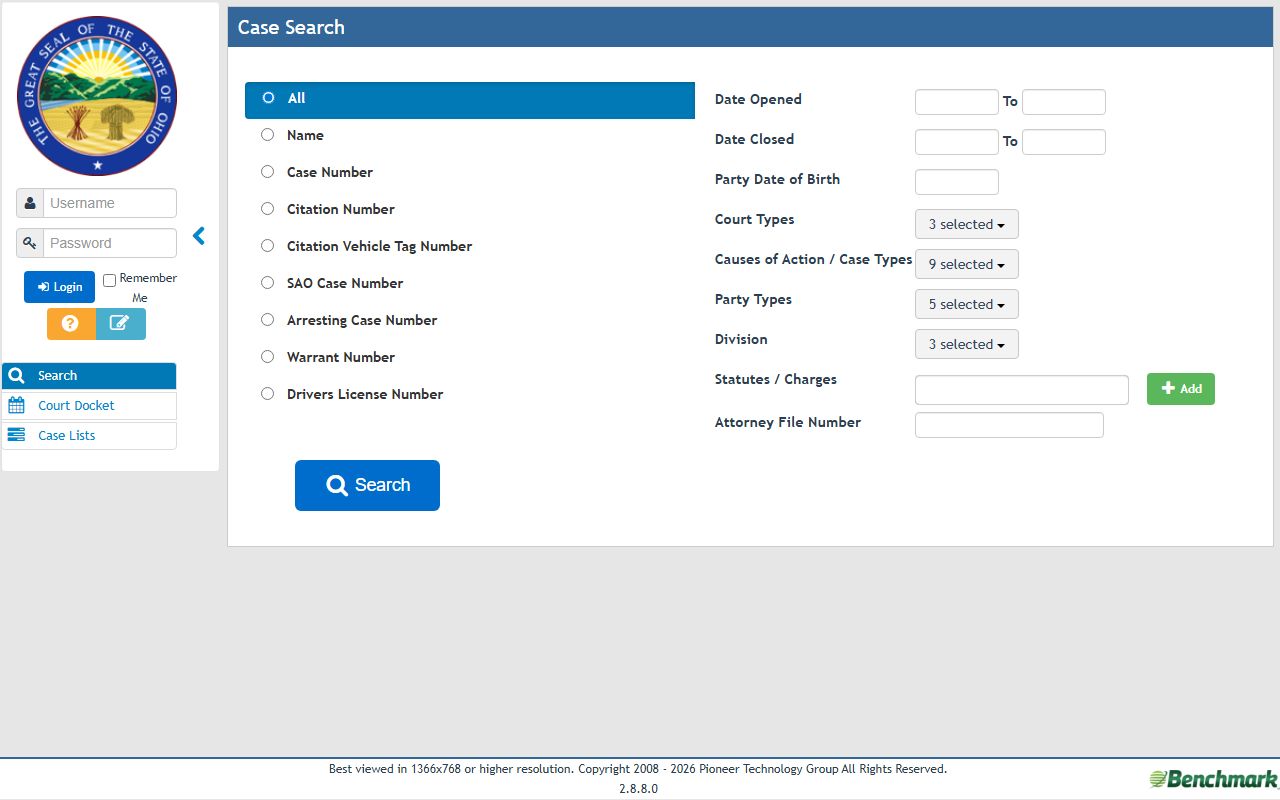
Those fields are useful when the roster gives only a partial charge label or when the arrest led to more than one case number.
Hocking County Arrest Search Fields
The Municipal Court search form is the richer field inventory located in the research. It can help with lower-level criminal, traffic, and warrant-linked matters. Common Pleas search is still needed when the case is felony criminal, has been indicted, or has moved beyond the municipal stage.
| Field Label | Type | Use |
|---|---|---|
| Name | Search category | Find a defendant or party when no case number is known. |
| Case Number | Search category | Open a known court case directly. |
| Citation Number | Search category | Traffic or citation-linked matters. |
| Arresting Case Number | Search category | Connect law-enforcement case numbers to court cases. |
| Warrant Number | Search category | Search warrant-linked court records when the number is known. |
| Date Opened / Closed | Date range | Narrow searches around an arrest or case filing period. |
| Court Types | Checkbox filter | Limit to criminal, traffic, tickets, or civil categories. |
| Statutes / Charges | Addable field | Search charge terms or statutory references. |
Charges Filed After Arrest
The charging document is the bridge between the jail arrest and the court record. It explains what the defendant is formally accused of in court. A roster entry may say probation violation, domestic violence, failure to appear, or another short charge label, while the court file shows the document, counts, levels, dates, prosecutor action, and later changes.
| Document | Filed By | Common Use | Why It Matters |
|---|---|---|---|
| Complaint | Officer or prosecutor | Often starts misdemeanor cases or preliminary felony proceedings. | Creates the first formal charge record. |
| Information | Prosecutor | Used when a prosecutor files a formal accusation, often with waiver or allowed procedure. | Can replace or refine earlier arrest labels. |
| Indictment | Grand jury | Felony charging document after grand-jury action. | Moves serious felony charges into Common Pleas tracking. |
Hocking County Felony Records
The Hocking County Clerk of Courts describes Internet Inquiry access for Common Pleas domestic, civil, felony criminal, Fourth District Court of Appeals cases originating in Hocking County Common Pleas Court, and Certificates of Judgment. The clerk page states public case records begin January 1, 1996, while Certificates of Judgment begin January 1, 2003.
Use Common Pleas for felony criminal cases, indictment records, bind-over cases, and higher-court docket activity. Clerk Rhonda Wykle's office is the source for official court-record copies. The research notes copy fees of $0.25 per page and $2.00 for certified copies, so certified court documents should be requested through the clerk rather than the jail.
The Common Pleas Internet Inquiry screenshot shows the public case-search portal used for felony and other Common Pleas case access.
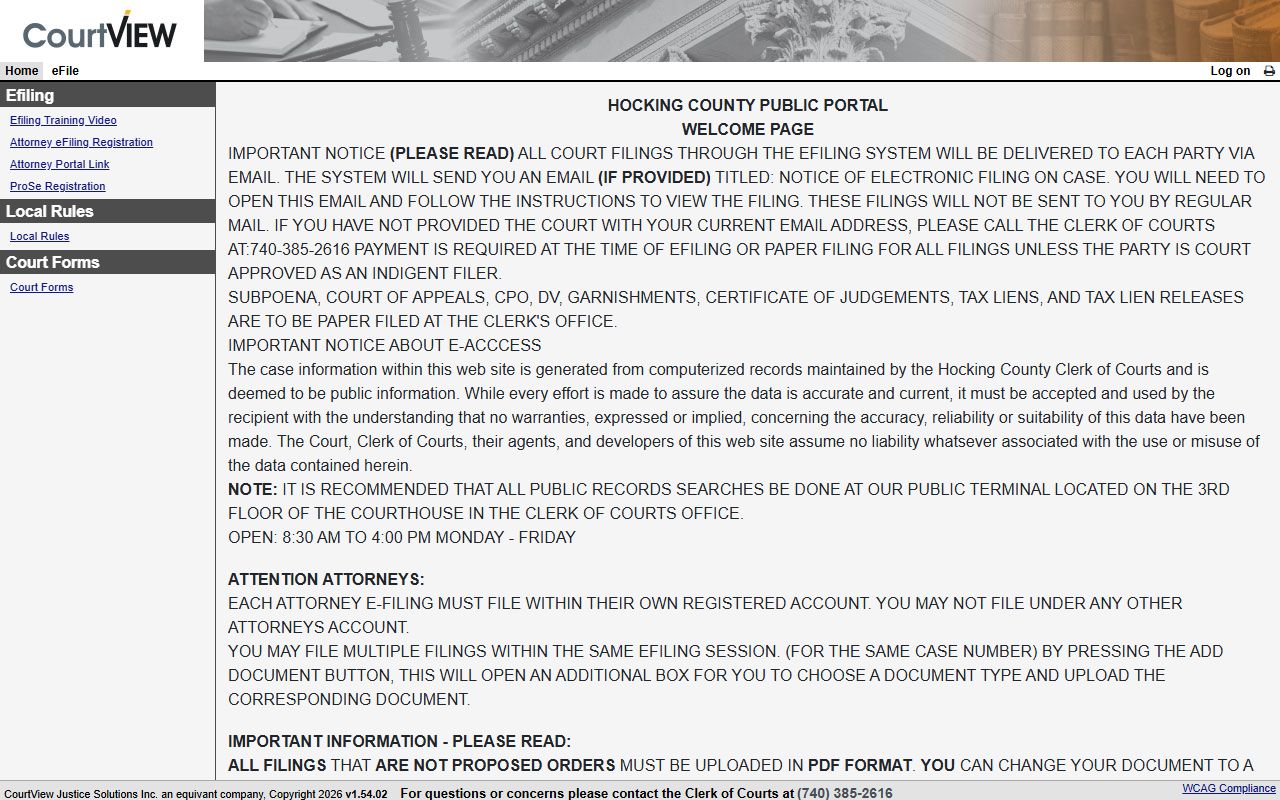
That portal is the better place to check a felony court record after the jail roster no longer tells the whole story.
Hocking County Charge Status
Charge status tells where the case stands, not whether the original arrest label was correct. Charges may be pending, amended, reduced, dismissed, bound over, indicted, resolved by plea, or sentenced. A roster disposition such as Recog, Sent, Time Served, Dismissed, or Court Ordered Release should be treated as a clue until the court docket confirms the legal effect.
| Status | Plain-English Meaning | Where to Verify |
|---|---|---|
| Pending | The charge is active and awaiting hearings, plea, trial, or other action. | Municipal or Common Pleas docket. |
| Amended / Reduced | The prosecutor or court changed the count, level, or wording. | Docket entries and charging documents. |
| Dismissed / Nolle | The charge ended without conviction, though records may still exist unless sealed or expunged. | Court disposition entry. |
| Bound over / Indicted | A felony matter moved from lower-court handling into Common Pleas. | Common Pleas Internet Inquiry. |
| Sentenced | The case reached sentencing after plea, verdict, or other disposition. | Court docket and, for prison, ODRC. |
Bond Records After Arrest
Bond can appear in the SEORJ Total Bail field, in a Municipal Court bond or fine schedule, and in a live court order. The roster value is a jail-facing snapshot. Before paying, confirm the exact amount, payment method, release eligibility, and any holds with SEORJ or the court.
| Release Type | Meaning | Local Note |
|---|---|---|
| Cash bond | Money bond paid directly for release. | Verify the current amount before payment. |
| Surety bond | Bond through a licensed surety or bail agent. | Do not rely on a roster number alone. |
| Recognizance / PR | Release based on a promise to appear. | SEORJ examples show Recog shorthand. |
| No-bond hold / detainer | Another court, agency, parole authority, or order blocks release. | A zero-dollar entry does not always mean release is available. |
The Municipal Court bond schedule screenshot shows waiverable offenses, payment options, and fine guidance for certain local matters.
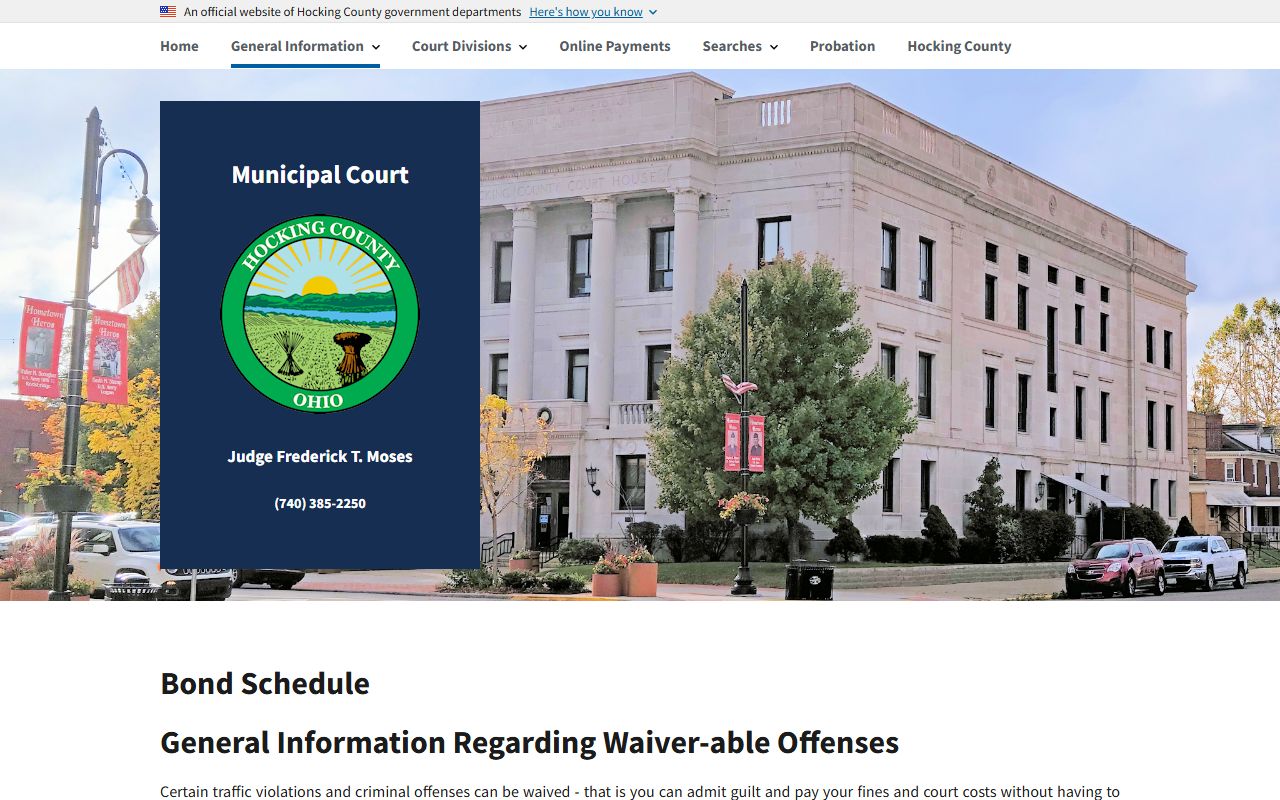
That schedule does not replace a judge's bond order in a specific case.
Warrants and Arrest Records
No standalone active warrant list was located on the Hocking County Sheriff's official pages. The sheriff site does describe a Warrants, Extradition and Prisoner Transport Division, and the Municipal Court search form includes a Warrant Number field. Court dockets may show bench warrants, capiases, failure-to-appear entries, probation violations, and warrant-linked case activity.
Do not rely on third-party warrant sites. Search the court docket, call the clerk or sheriff for routing, or contact an attorney. A warrant can lead to immediate arrest, and a bond in one case may not release a person if another warrant, APA holder, or detainer remains.
Charges vs Convictions
A charge is an accusation or filed count. A conviction is a result after plea, verdict, or other legal finding. Hocking County court records after an arrest can show both, but the distinction matters for employment, licensing, housing, immigration, and sealing questions.
| Point | Charge | Conviction |
|---|---|---|
| Case stage | Filed or alleged offense. | Final finding after plea or verdict. |
| Proof level | Based on probable cause or charging authority. | Requires conviction standard or admitted plea. |
| Can change? | Can be amended, reduced, or dismissed. | Can be appealed, sealed, expunged if eligible, or used at sentencing. |
| Where shown | Jail roster and court docket may both show versions. | Court disposition, sentence, and sometimes ODRC profile. |
Sealed or Expunged Arrest Records
Ohio law treats sealing and expungement as record-clearing paths for eligible cases, but eligibility depends on the record type, charge, outcome, waiting period, and exceptions. Ohio Revised Code 2953.32 covers sealing or expungement of eligible conviction or bail-forfeiture records. Ohio Revised Code 2953.33 covers not-guilty findings, dismissals, no bills, and pardons.
| Record Action | Effect | Hocking County Search Impact |
|---|---|---|
| Sealed | Public access is limited by court order. | A case or charge may stop appearing in ordinary public search results. |
| Expunged | Record is destroyed, deleted, or treated as removed where law allows. | Agencies may need a court order before changing public records. |
| Not eligible | Record remains public unless another exemption applies. | Verify with the court, not the jail roster. |
Restricted Hocking County Records
Ohio Revised Code 149.43 makes many public-office records available for inspection and copying, but it also includes exemptions. Juvenile records, sealed cases, confidential law-enforcement investigatory records, medical information, security-sensitive records, and some victim or witness details may be restricted or redacted.
Important: Hocking County court records after an arrest should be verified with the court or agency that created the record.